 Liqee
Liqee tokenization: tTokens as collateral
Last updated:
The documented design used tTokens to represent staking and mining assets as collateral in Liqee's lending market. Each certificate had specific underlying backing, and borrowing depended on acceptance in the relevant market.
Blockspot lists Liqee as discontinued, although its entry gives conflicting shutdown dates. Current tToken issuance and redemption availability is unconfirmed; the specifications here describe the historical design.
Mining assets and validator deposits
- tFIL
- A certificate backed by Filecoin pledged for mining and associated mining equipment.
- tXTZ
- A certificate representing collateralized XTZ deposits from Tezos validators.
The backing of these certificates differed by asset. Their descriptions did not establish a shared conversion rate or redemption timetable.
StaFi's rTokens represented assets staked through StaFi and provided another documented form of collateral when supported by Liqee. Using an existing staking representation in lending was a different task from tokenizing mining assets or validator deposits through Liqee's tToken model.
Using a certificate as lending collateral
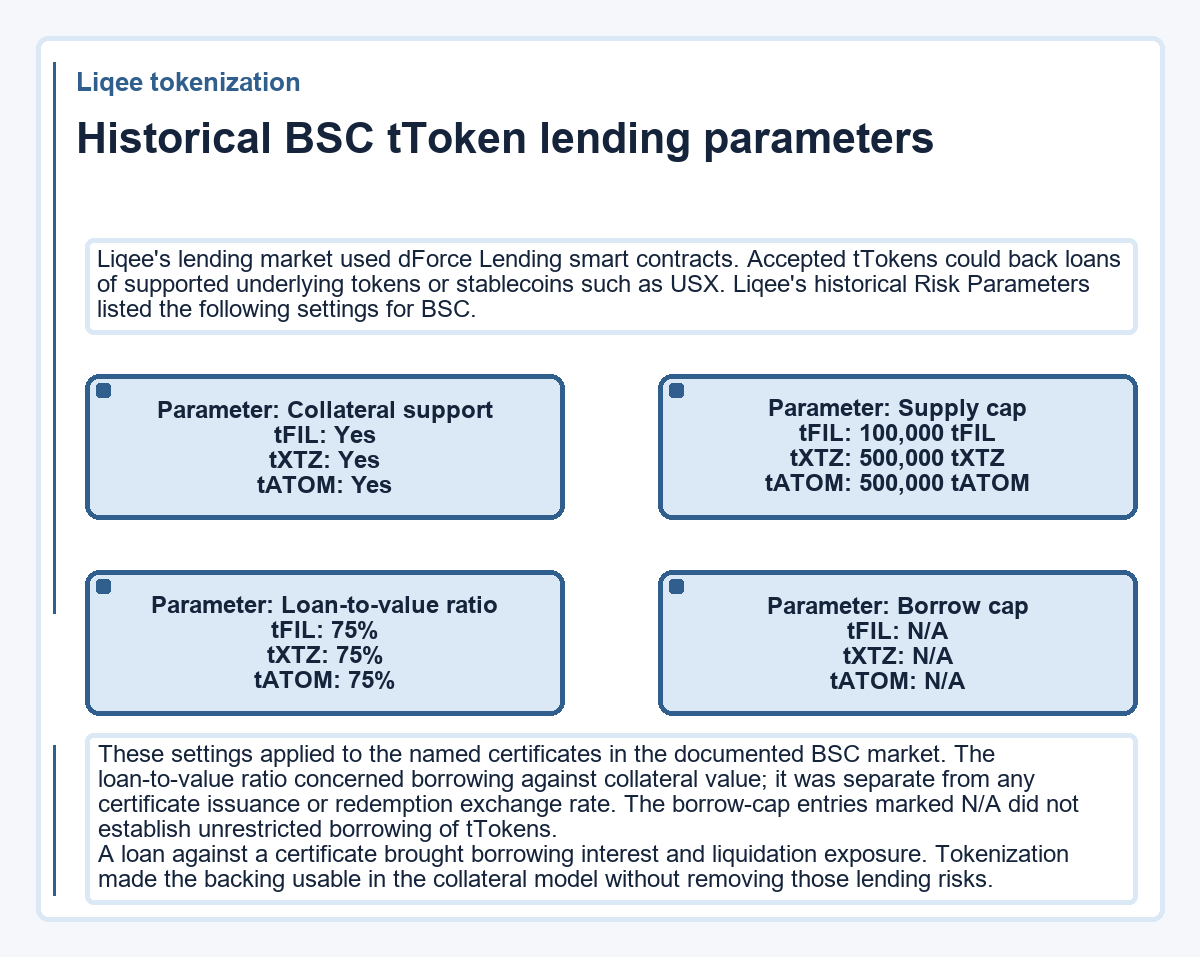
Liqee's lending market used dForce Lending smart contracts. Accepted tTokens could back loans of supported underlying tokens or stablecoins such as USX. Liqee's historical Risk Parameters listed the following settings for BSC.
| Parameter | tFIL | tXTZ | tATOM |
|---|---|---|---|
| Collateral support | Yes | Yes | Yes |
| Supply cap | 100,000 tFIL | 500,000 tXTZ | 500,000 tATOM |
| Loan-to-value ratio | 75% | 75% | 75% |
| Borrow cap | N/A | N/A | N/A |
These settings applied to the named certificates in the documented BSC market. The loan-to-value ratio concerned borrowing against collateral value; it was separate from any certificate issuance or redemption exchange rate. The borrow-cap entries marked N/A did not establish unrestricted borrowing of tTokens.
A loan against a certificate brought borrowing interest and liquidation exposure. Tokenization made the backing usable in the collateral model without removing those lending risks.
Tokenization charges and lending costs
Liqee's tokenization fee design called for a flat charge upfront or on exit, with the proceeds to be pooled into protocol fees. It gave no fee amount.
The lending FAQ separately listed no protocol charge for supplying assets or originating a loan. Those terms did not make tokenization free. Borrowers still owed interest, and part of the lending interest spread funded a reserve.
Exit terms and responsibility for backing
A lending withdrawal concerns the asset supplied to a pool. Redemption concerns the backing represented by a certificate. Liqee's lending FAQ made withdrawals subject to available liquidity in the pool for that same asset; those terms did not specify how or when a tToken's underlying backing could be released.
Liqee's Audit Reports document attributed the cited security reviews to dForce Lending code and described dForce's assistance with deployment, collateral onboarding, and initial risk settings. A review of lending code alone did not establish the backing or redemption terms of an individual tToken.