 Liqee
Liqee liquidations: debt limits and losses
Last updated:
A loan became eligible for liquidation when it no longer met the collateral requirements of Liqee's dForce-based lending model. A liquidator could repay an eligible portion of debt and receive collateral with an incentive. Liqee's historical lending parameters listed a 10% liquidation bonus, increasing the collateral cost associated with that repayment.
- Market scope
- Historical lending markets on Ethereum and Binance Smart Chain (BSC), with collateral limits that varied by asset and network.
- Operating status
- Blockspot lists Liqee as discontinued, but gives conflicting closure dates. These historical terms do not establish current access to repayment or liquidation functions.
How a position reached its collateral limit
- Loan-to-value (LTV)
- The maximum portion of collateral value that supported borrowing. Liqee's historical Risk Parameters listed StaFi's rETH at 70% LTV on both Ethereum and BSC, while ETH and USX were listed at 80% on both networks.
- Outstanding debt
- The obligation that the collateral had to support, including accrued borrowing interest. A repayment reduced that obligation; continuing interest could increase it.
- Collateral headroom
- The margin remaining under the applicable collateral test. Changes in collateral value relative to debt, or additional borrowing interest, could reduce that margin.
Gross collateral value alone did not establish that a loan met its requirements. The documented dForce model weighted collateral value by LTV and divided each debt value by its asset's Borrow Factor. When the resulting collateral-to-debt ratio, called the adequacy ratio, fell below 1, the loan was eligible for liquidation. A position could therefore breach its collateral requirement while its assets still had a greater gross value than its debt.
Liquidation eligibility also differed from execution. A breached requirement made the position subject to liquidation; it did not establish that a liquidator had already repaid debt or taken collateral.
What liquidation changed
In the documented dForce Lending mechanism underlying Liqee's design, liquidation paired debt repayment by a liquidator with seizure of the borrower's collateral. The incentive increased the collateral value received above the value of the debt repaid.
Liqee's historical 10% bonus concerned that liquidated repayment portion. It did not mean that every affected account lost exactly 10% of its entire collateral balance. The amount repaid, the applicable incentive, and the collateral valuation determined the transfer; remaining debt could still require attention.
Comparing the same debt reduction
For this hypothetical comparison, the permitted debt repayment has a USD value of 618. Assume sufficient collateral and unchanged protocol valuations during execution, and apply Liqee's documented historical 10% liquidation bonus. The repayment value and execution assumptions are hypothetical.
Voluntary repayment would reduce debt by that USD value without a liquidation seizure. If a permitted liquidation instead repaid the same portion, the collateral value transferred would be
618 * (1 + 0.10) = 679.80
USD. The bonus component would be
618 * 0.10 = 61.80
USD.
The liquidation would therefore exchange collateral valued at 679.80 USD for a debt reduction valued at 618 USD. A smaller permitted repayment would reduce both the transfer and the bonus proportionally at the same rate. This calculation concerns only the repaid portion, excludes transaction costs and intervening interest or price changes, and does not establish that the remaining position would meet its collateral requirements.
Repayment and pool liquidity
Liqee's documented repayment terms allowed partial or full repayment, with interest calculated through the block of loan termination. Partial repayment reduced debt, but could leave a position exposed if the remaining obligation still exceeded its collateral-based allowance. Voluntary repayment before liquidation avoided seizure of collateral for the repaid portion.
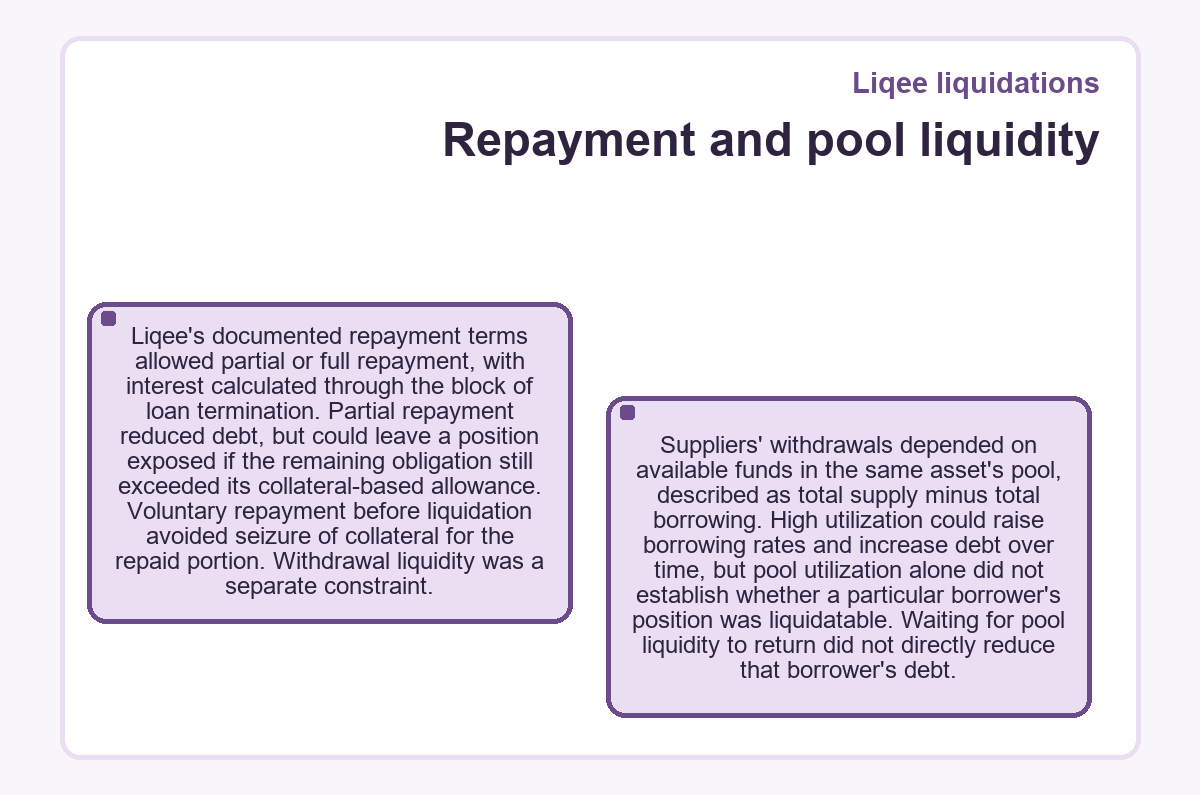
Withdrawal liquidity was a separate constraint. Suppliers' withdrawals depended on available funds in the same asset's pool, described as total supply minus total borrowing. High utilization could raise borrowing rates and increase debt over time, but pool utilization alone did not establish whether a particular borrower's position was liquidatable. Waiting for pool liquidity to return did not directly reduce that borrower's debt.